


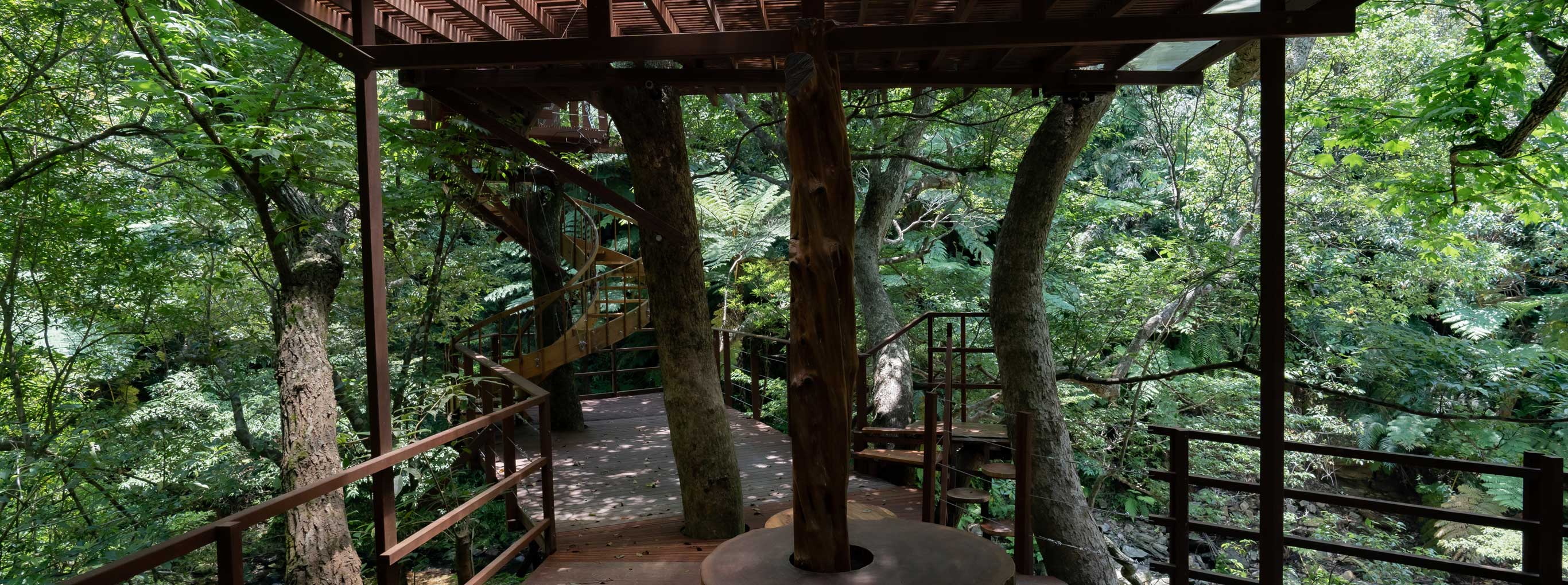
Satoru Kikugawa, the owner of Treeful, had a childhood dream: “to build a treehouse.”After reading the picture book *I Want a Big Tree* as a child, he wanted to build a treehouse in a large tree himself. However, he didn’t want to build it just for himself; he also wanted visitors to the treehouse to experience the wonders of nature and understand the importance of coexistence between humans and nature. Therefore, from the very moment he began construction in 2014, he was determined to create a “treehouse resort.”
What's the most important thing when building a treehouse? Finding a big tree.
Akira set his sights on northern Okinawa, where pristine virgin forests still remain, and began by searching for the right tree. When he asked local real estate agents in Okinawa, they could only tell him that while trees were growing there, they had no way of knowing how large they were. He eventually met an Okinawan real estate agent willing to help him search for a large tree, and together they explored the forests of northern Okinawa. When he found the massive Akagi tree that would become the host tree for the current Spiral Tree House, Akira embraced it and thought, “This is it!”
From a young age, my daughter Manyo’s father, Akira, would take her out to play in nature almost every week. Raised in such a natural environment, she’s always felt a desire to give back to nature. This led her to visit the treehouse resort in Costa Rica—which ultimately inspired the project—with her father, Akira, and to help with the construction of a treehouse in Okinawa, starting with the search for suitable trees.
Akira had loved building things since he was a child, but since he didn’t have the skills to build a treehouse large enough for people to sleep in, he faced a series of failures at first. The first one he built was what is now called the “Party Tree Deck.” He connected five trees to create a wooden deck 2.5 meters above the ground, 4 meters wide, and 5 meters deep. He set up a tent on top of it, and thus his first simple treehouse—one that could shelter him from the rain—was complete.
To improve my skills, I learned how to use and make tools by watching YouTube videos. Next, I set out to design and build a spiral treehouse—featuring a spiral staircase—around the beautiful Akagi tree that ultimately convinced me to purchase the land at Treeful.
The key focus of the treehouse design is to create a "real treehouse."
In other words, a treehouse should be supported entirely by a living tree; if it has posts touching the ground, it cannot be called a treehouse. Furthermore, I was determined to include a spiral staircase that would fit the shape of the Akagi tree. So I came up with the idea of suspending the treehouse and the spiral staircase from the tree’s branches using wires. After trying various methods to solve the problem of leaks, I resolved it using a system that incorporates non-woven fabric and secured a patent for it.With a strong focus on design and in compliance with NASA safety standards (“One Fail Operational, Two Fail Safe”—meaning a design where the mission continues even if one failure occurs, and safety is maintained even if two failures occur)—the Spiral was finally completed after several years of trial and error.
At the same time, he was working on the Egg House. Since Akira had been into sailing as a hobby since college, his initial idea for the Treeful Project—when it wasn’t yet clear whether building a treehouse was legal—was, “I’ll just build a boat and put it up in a tree.A boat should be able to be moored anywhere.” The reason for the egg shape was that an egg is full of dreams—you never know what will hatch from it. He designed it himself, melted down milk cartons to make a model, took it to a boat builder in Yokohama to have it constructed, actually sailed the Egg House in the waters off Okinawa, and registered it as a small vessel. He then transported it to Genka in Nago City, where Treeful is now located, and placed it atop a tree.
By that time, my skills as a treehouse builder had improved significantly compared to when I first started, and my team had grown. I wanted to transform the very first party treehouse I’d built into a more sophisticated structure, which led me to come up with the “12-sided corridor” on the second floor of the Party Tree Deck. While it would have been easy to create a simple corridor by laying straight planks, Akira’s commitment to detail is evident in his decision to go to the trouble of making it 12-sided—a process that takes many times longer.The shape was inspired by the bones of vertebrates. It’s easier to visualize if you imagine a whale’s spine and ribs. The design serves as a symbol conveying the message that humans can draw on a wealth of wisdom and mechanisms from animals and other living creatures. Today, the Party Tree House serves as a place where guests can enjoy dinner by the campfire, host parties, and gather together.
The Golden Trophy Treehouse is a Japanese-style treehouse inspired by Kyoto’s Kinkaku-ji Temple, where visitors can enjoy the traditional Japanese tea ceremony. The central pillar supporting the treehouse is shaped like a “tsuzumi” (a traditional Japanese drum).Recalling a tsuzumi-shaped chair from a vacation home in Karuizawa during my childhood, I incorporated that design into this treehouse. The roof is made of washi paper, and when the lights are turned on at dusk and viewed from the outside, it glows golden. This treehouse, which I highly recommend seeing at night, was completed in 2020.
The newest treehouse is the "Boot Treehouse," which features a spiral staircase inside and can be used as a standalone accommodation. Construction is currently underway on a 12-sided treehouse.
To protect nature, we avoid cutting down trees as much as possible. The treehouse itself is not just carbon-neutral, but carbon-negative. To avoid disturbing the animals and plants living on or beneath the ground, all structures—including the Aero House—are built at least 1.2 meters above the ground.Since the metal bolts used in treehouse construction generate 2.2 times their weight in carbon dioxide during factory production, we have filed a patent application for wooden dowels. Instead of a lawn mower, we use Donna the goat. We also use composting toilets and an EcoCute water heater that uses surplus late-night electricity to heat water. Furthermore, rather than using chlorine for disinfection, we sterilize water from a hand-dug well using ultraviolet light. Water containing chlorine unnecessarily kills microorganisms.Currently, we are also moving forward with an off-grid project to generate our own electricity using old car batteries and solar panels. We are implementing various measures to achieve a sustainable society.
After overcoming various obstacles and spending seven long years, we finally opened as a resort in August 2021, fulfilling Akira’s childhood dream. This was made possible thanks to the support of local residents and our team, who shared our vision of “coexisting with nature.” The guests who stay at Treeful are our valued “partners” who learn about the importance of coexisting with nature and help spread that message.